Showing posts with label brazil. Show all posts

Thursday, December 22, 2016

Lots of highs, few lows: a trip round-up

I've been back in the UK for six weeks now - six weeks which have flown by just as fast as the six weeks I spent travelling and the weeks in Rio. Every time I've seen a friend for the first time since returning they've asked me what the best bit was, usually prefacing with "how was the Olympics?" At that point I've usually gone "oh yeah, the Olympics, I did that too". The travelling part of the trip, being more recent and immediate, had somehow taken priority over Rio in my head.

I blogged about both the Olympics and Paralympics earlier and the memories are still strong. The ones I've been dragging out when people ask tend to be:
  • the lovely chat I had with single sculls champion Mahé Drysdale before racing started, because it genuinely was just a nice conversation with a nice guy;
  • watching the GB women's eight win silver, because over the years I've known a number of the women who have been fighting for that medal for so long; 
  • being in the athletics mixed zone on the night of the men's 100m final and squishing into the front of the agency pen to grab Usain Bolt's quotes (that man is TALL - my arm was aching from holding my phone up to record);
  • the many, many incredible stories from the Paralympics, but maybe most that of Australian para-canoeist Curtis McGrath. We sat in the shade in the boat park and he told me, with perfect clarity, about the moment on 23 August 2012 when he'd lost his legs in an IED explosion in Afghanistan. It was only moments later, being stretchered to the helicopter, that he told his mates they'd see him at the Paralympics. Some of them were in Rio to watch him win gold four years later. It was hard to listen and ask questions without getting emotional.
The Lagoa at dawn
But those are just a handful of the many moments I'll remember from those two and a half months in the Cidade Maravilhosa, shared with a great bunch of colleagues and friends.

When it comes to best experiences from the travelling, the Salkantay and Machu Picchu probably top the list. I had such high expectations from the trek and they were met almost entirely, which is saying quite a lot. Iguacu Falls is also up there as one of the best bits of the trip. The sheer power of all that water was just astounding - and I got to go to Argentina for the day!


But I also loved Ilha Grande and wished I'd stayed there longer; I was very pleasantly surprised by Lima, which everyone had said wasn't that great a place; I chilled out with the locals by Lake Titicaca; I was awed by condors in Colca Canyon; and saw pelicans in a place that looked like the moon in Paracas. I stuffed my face with steak in Brazil and with livelier fare in Peru, and drank somewhat more than my fair share of capirinhas and pisco sours as well as plenty of ice-cold beer.

With my Lake Titicaca homestay host Calixto
Along the way I encountered all sorts of interesting people, from the wonderful locals who were my guides and hosts, to other travellers. Young couples taking career breaks, older solo travellers looking for something new, backpackers from all over the world stretching their money as far as it can go. And of course in Rio a whole host of fantastic cariocas who were so generous with their welcome to their city. 

In many ways it's odd looking back at the journey. At the beginning of the year I was tired, trying to give as much time as I could to work and to rowing and not quite succeeding on either level. I felt like I'd been operating at maximum capacity for far too long. And I really wanted to work in Rio, having spent the best part of four years looking back wistfully to the London Olympics. When the offer came through I was on a long weekend break in New York, seeing my brother and sister-in-law and enjoying a brief few days of travel - it seemed appropriate that I spent much of that weekend buoyed up with anticipation over Rio too.

It was difficult in some ways leaving my job. I worked with an awesome team and the job itself was interesting, varied and challenging. But I'd been there a while and the changing shape of the world of business media was getting me down. Taking the leap into Rio, travelling and then the challenge of trying to go freelance was absolutely the right thing to do. Writing this now, despite the fact I haven't really put much effort into getting work yet, I feel refreshed and excited about next year. Planning is overrated - I'm going to see what happens and seize any opportunities that come. It seemed to work this year, after all.

Thanks for following my travels with me. Until next time!

Friday, October 7, 2016

Brazil round-up

I am shamelessly stealing the concept of a country round-up from my friends and fellow travellers Julie and Andrew and their Two Year Trip blog. I've actually been in Peru a week now so a Brazil wrap-up is overdue ...


Why go to Brazil?

I'm not sure I can really say I properly visited Brazil. I saw a very small part of a very big country and to do it justice would need months. Nevertheless, I recommend Brazil for:
  • Beaches. The Brazilians do love their beaches, especially in Rio.
  • Samba. I didn't go to a proper samba night but the sound of the music is everywhere and I experienced some of the dancing at the Olympic closing ceremony. It's kind of infectious.
  • Amazing scenery. From Rio's mountains to the forest of Ilha Grande via Paraty's turquoise sea and Iguacu's astonishing waterfalls, Brazil really is a strikingly beautiful place.
Top three Brazilian experiences I had:
  •  A very Olympic/Paralympic-related one: hearing the partisan support of the crowds for their idols, particularly canoe sprinter Isaquias Queiroz dos Santos during the Olympics and Daniel Diaz at the Paralympics. And seeing the ensuing press scrums in the mixed zones after they won medals. Bonkers.
  • Seeing Iguacu Falls.
  •  Walking to the top of Corcovado to see Christ the Redeemer. The views weren't great that day but it was a lot of fun.
You know you're in Brazil when ...
  • There's someone drinking beer at 10am on a weekday. 
  • You can't walk 100m without seeing either a) a self-serve restaurant or b) a pharmacy.
  • Every meal involves meat, rice and beans. 
What to pack when going to Brazil:

Your tiniest bikini or swimsuit. Everyone else is wearing one, after all. (Don't worry about packing flipflops, Havaianas are ridiculously cheap in Brazil!)

Annoyances and things to look out for:

I can honestly say that I felt unsafe only a couple of times in the whole time I was in Brazil, and by 'unsafe' I mean I felt a little unhappy that I was in a particular spot by myself. I was careful not to carry too much money or my credit cards around, but I did always have my phone and usually my camera - a good Canon DSLR - on me. I tended to keep my camera in my bag until I needed it, and a couple of times I literally got it out, took a picture and put it away again, but I never felt like my camera was making me stand out. I stand out anyway in South America just by dint of being fair-skinned and fairly fair-haired. Not having my camera is not going to make me look any less a foreigner!

That said I did hear about people being robbed in Rio. A colleague had his wallet taken, we think from the 'hippie market' outside General Osorio metro station in Ipanema on a Sunday. It's worth leaving your passport and most of your cards back at your hotel otherwise you do risk them going with everything else. Basically my tip would be to look like you know what you're doing, be sensible, and you'll be fine.

Money: use ATMs inside banks. You may find paying for something with a R$100 note is tricky - I found supermarkets and restaurants were happy to take them but few other places were.

Transport: in Rio, the metro is good and relatively cheap, and easy to navigate, although its destinations are moderately limited. The BRT (bus rapid transit) system is also good but the buses tend to be rammed. The 'Supervia' trains which leave from Central station are also pretty good but do not go at the advertised time. I had no problems on ordinary buses in Rio either, but I did only use them during daylight hours. In Sao Paulo, the metro is excellent and cheap, although annoyingly you have to buy single tickets one at a time when you need them. In both cities Uber was a cheaper alternative to taxis, and saved having to explain destinations! 

What I'll miss most about Brazil:

Probably the people. The Brazilians I worked with were awesome and welcoming and wanted everyone to have a good time. And I did. Obrigada a todos!

Sunday, October 2, 2016

Iguacu and Iguazu Falls

I love a waterfall. I always try and hunt them out when I'm travelling or walking and have especially fond memories of an awesome day waterfall-hunting in the Catlins, New Zealand. There's something about the simple primal force of a lot of water falling off the edge of a cliff which fascinates me.

So when I was researching this trip Iguacu Falls very quickly made it on to my list.

Iguacu is widely regarded as being one of the world's greatest waterfalls and rightly so. It's not one fall at all, but 275, strung out along kilometres of cliff edge and spanning the Brazil-Argentina border. Technically I think Argentina has the greatest volume of falls of the two countries and certainly it takes longer to see the falls from that side. Both sides have walks and boat tours; Brazil takes you from the visitors' centre at the entrance to the falls in double-decker buses and Argentina takes you in a little narrow-gauge train.

Brazil side - Iguacu


The Brazilian side of the falls is a bit more modern and professional than the Argentinian side, and it is from Brazil you get to see the full scope of the place. There's one key trail, the Trilha dos Cataratas, which runs about 1.5km along the cliff and gives you a great view of most of the Argentinian falls and culiminates in a viewpoint right below the main fall, Devil's Throat, where gallons and gallons of water pour into the abyss.

A bad selfie. It had to be done.
The best time to go from an aesthetic point of view is in the morning when the mixture of sunshine and spray create stunning rainbows. Sadly this is also the worst time to go from an experience point of view, as the rest of the world also turns up then on buses and the place is packed. As there's basically one trail there's not many places for people to go to and the major viewing spots on the morning I visited were just packed with tourists, mostly taking selfies, as we live in a very narcissistic world these days. Mind you I took one too, just because.

Most of the views on the Brazil side are views from a distance but the walkway also takes you right up to the Devil's Throat (take a raincoat, or buy a plastic poncho for R$6). It's pretty cool to stand there underneath the waterfall.


At the end of the trail there's a panoramic elevator for people who can't walk up the stairs/are too lazy to walk up the stairs, and more views from above. And the obligatory café/restaurant complex, where I had a surprisingly good coffee.

Argentinian side - Iguazu

I did a whole separate blog post about getting from Foz do Iguacu to Puerto Iguazu by public bus, because online information is limited, and because if you're reading this to look at pretty pictures of waterfalls you don't need to know that I missed my stop coming home and had to walk an extra half an hour.

The Argentine set-up is similar to the Brazilian one but the park covers a lot more ground and there are more trails to walk. I spent most of the day in Argentina and only a couple of hours on the Brazil side of the falls. It feels less polished somehow and because there's more to see the crowds are thinner. I'd say that the Argentinian experience is more up close and personal while Brazil is the overview.


Annoyingly the longest trail, which is where they say you can see some wildlife, was closed so I couldn't do that but I did see a few birds and animals anyway - a wild toucan from a distance, some monkeys, and lots of other birds.

Like the Brazil side there are lots of coatis around. These racoon-like animals are quite cute to look at and voracious scavengers. They love human food and there are signs everywhere warning you not to feed them - although people were. When I stopped for a bite to eat there was an Argentinian couple nearby with a plate of empanadas and a bottle of Coke on their table. A coati prowling the food area spied the empanadas, jumped on to the table, grabbed an empanada and spilled the Coke much to the anger of the couple. The man was so angry or possibly distressed he flung a chair at the poor animal (and got Coke all over his shorts. I couldn't help smiling). Another coati promptly arrived to lap up Coke from the ground. It's definitely not good for them but they do seem to love junk food.

I also did the boat ride on the Argentinian side, a short and very very wet baptism. Basically they drive you into two pretty sizeable waterfalls including the one on the left of this paragraph. And then they do it again. It's cold and the power of the water, even at the edge, was crazy. Everyone in my boat squealed a lot including me. It was crazy and fun and worth the money I spent on it (450 pesos, or about £23).

The day finished up at the Devil's Throat again, but this time from above. Literally all you can see is the edge of the cliff, which is a U-shape, and a few metres of water before a cloud of spray. I knew from the Brazil side how high the fall is but hadn't appreciated how high the spray reaches. Everyone on that lookout point was soaked (hurrah for my rainjacket).


Iguacu extras

There's not much to Foz do Iguacu apart from the falls and, if you're into that sort of thing and have space in your bag, cheap shopping at the duty free shop between the Argentine and Brazil borders or in Ciudad del Este, Paraguay, which is literally just the other side of the river.

Two extra things I did do:

The Parque des Aves is right next to the Brazilian falls visitors' centre and was superb. This bird sanctuary looks after and breeds a whole range of birds, mainly native to South America. The best bit about it was their huge aviaries which you can walk inside and really see the birds close up, without cage wires in the way. I especially loved seeing a toucan right in front of me and the macaw aviary, filled with beautiful parrots.

Itaipu Dam was voted one of the seven modern wonders of the world and they have a busy tourism (or, as the Lonely Planet quite accurately put it, propaganda) machine to go with the generation of 75 per cent of Paraguay's electricity and about 15 per cent of Brazil's. Due to a string of minor events I failed to get on one of the 'special' tours which take you inside the dam, but managed to do a 'panoramic' tour which drives you round the outside in a double-decker bus. They didn't mention the impact building this massive dam must have had on the Parana river and the people who lived in the area. The reservoir covers an area that's bigger than New York City or Rio de Janeiro - it's massive. A little research reveals that the creation of the dam destroyed the Guaira Falls, which sound like they were even more impressive than Iguacu. So generating clean energy had major environmental repercussions, and that's not touched on at all on the tour. Still, it was interesting to see the dam and it filled a morning I had to fill.

Saturday, October 1, 2016

Food and drink in Brazil

There's a fair bit I'll miss about Brazil, but I'm not sure the food is really one of them. Don't get me wrong, I've eaten well, but I've got a little bored of the monotony of the cuisine - you have to go out looking for alternatives.

Brazil's cuisine is best known for and mainly characterised by meat. Lots and lots and lots of meat. I'm not sure I've managed more than one or two days without meat in at least one meal in some form or another. To be fair, when it comes to steak the Brazilians have it nailed - their beef is superb. The best steak I probably had was in a restaurant in Rio called the Braseiro da Gavea, along with a bunch of ONS-ers, but I had a pretty good and very rare one for less than £10 in Lapa one night too.

To accompany the piles of meat Brazilians like to add piles of carbohydrates. Now, I'm not a carb-hater, but I do feel that bringing a massive dish of rice plus a massive dish of chips or potato to go with your steak, fish or whatever is overkill. The most popular forms of rice are plain, or broccoli rice, which is rice mixed with very finely-chopped broccoli - it's rather good actually.

Typical mixture of salad, rice, beans and farofa (the meat came later)
To go with your rice and meat you must have two things: beans, and farofa. At the Olympics and Paralympics every meal had the option of rice and beans. The beans are usually black, sometimes red, and at weekends the thing to eat is feijoada or bean stew, which is essentially the same thing with extra meat in it.

Farofa was quickly christened 'sand' by us ONS gringos. It's toasted cassava flour which sometimes has other stuff mixed in, such as eggs, bacon, or garlic. I've actually come to quite like it; farofa adds texture to your rice!

Tilapia seems to be the most common fish and we had it loads during the Olympics. 

Brazilians have big lunches - when we were staying in Centro the restaurants opened at lunch and then closed at dinnertime, although in less business-minded areas there are plenty of places for dinner too. Buffet restaurants are the thing, either for a set price or with prices per kg or per 100g.

When I'm travelling I don't like big lunches, and at the Olympics I tended to have a massive lunch and then not need much dinner. So I've also investigated Brazilian snack and street food a fair deal.

Their biggest thing is pasties of various descriptions, usually containing meat (of course) or sometimes just cheese. They're either baked or fried. I think the most unfortunate one I got was a bit like a doughnut, except filled with the rubbery white cheese they eat a lot. The mortadella pastel I had in Sao Paulo was excellent. You can find variations on on the pasty everywhere for very little money - usually somewhere around R$5, or just over £1. Some places also do 'sandwiches' for a similar price which are generally toasted and minuscule. A 'misto quente' is basically a ham and cheese toastie.

My first tapioca from a place in Rio
In Rio I also tried both kebabs from street stalls, which were great, and had tapioca pancakes once or twice too. 'Tapiocas' are incredible things. The stallholder has a hot plate and a ring mould and spoons raw tapioca flour into the mould. They flatten the flour down and let it toast and somehow it all sticks together. Then they put a toppping on (ham and cheese and tomato was my favourite), flip it, let the topping cook, fold it and serve it. They're really good.

Although Brazilians have pretty sweet tooths (teeth?) they're not massive on pudding. But I did have a lot of cake with my breakfasts. Cakes are often made in ring moulds, usually involve coconut, and are called 'bolos' when they're that shape. Churros on street corners are also common and you can get sweet tapiocas too.

The breakfasts everywhere have been the same rule of thumb: fruit, usually melon and pineapple and sometimes mango; bread; scrambled eggs if you want them; and cake. Sometimes yoghurt. Also pao de queijo, which are little balls of a sort of cheesy bread and are very good.

Brazil is a pretty multicultural country and there are places serving foreign cuisine, but mainly in the big cities or touristy areas. Italian is everywhere but quality varies - I had a couple of very middling pizzas and a couple of really good ones, for instance. The other night in Foz do Iguacu I had a good Lebanese meal - apparently Foz is one of the biggest Lebanese settlements anywhere. Sao Paulo is a massive Japanese city and there are a number of Japanese restaurants as a result. That said, the Brazilian combination of meat/fish plus rice plus other carb of choice is common in many restaurants, even those which profess to be serving other food!

Decent coffee has been surprisingly difficult to find. In hotels and at the Olympics it was generally filter and very strong and the Brazilians normally drink it in tiny cups the size of shot glasses with masses of sugar. I don't drink milky coffee but reports from friends suggest that cappucinos and lattes came with sweetened milk too. I've had a few good coffees but it's been hard to find, which is weird when you consider Brazil is the world's largest producer of arabica!

All the snack bar, or 'lanchonete', places serve juice, freshly-squeezed, which is lovely to go with your pasty. Brazilians also like iced tea, and here it's a version called mate. If you buy it readymade in a bottle it's exactly like the iced tea you get in the UK but if you get it in a cup as I did once from a chain which specialises in mate it's more bitter in taste.

As a side note to this, on the Argentinian side of Iguazu Falls loads of people were lugging around huge thermos flasks and little cups, which I think is to provide them with mate throughout the day. A bit like the good old British flask of tea I guess, but we don't tend to carry ours around while we go on a walk to a waterfall.

The two principal alcoholic beverages of choice in Brazil are beer and cachaca. Beer is drunk everywhere, at any time, mostly very very cold lager-style beer. You can get cans at street food stalls and snack bars and petrol stations (yup). It's mostly served either draught, in small glasses which are called 'chopps', or in 600ml bottles to share between your party with tiny glasses to drink it out of. The big bottles come in their own special cooling covers to keep them icy. Beer also comes in 'long necks', which are usually 355ml bottles. The most common brands are Skol (the Olympic/Paralympic beer, tasteless and cheap), Brahma (drinkable) and Antarctica (similar to Brahma). Slightly up-market are Bohemia and Original and Serramalte is another step up in price usually, if a bar serves it. I found a couple of microbrewery places which had a wider range of beers such as wheat beer or stout but generally lager's what you get, and very nice it is on a hot day.

Cachaca is a rum-like spirit distilled from sugarcane which is the base ingredient for the ubiquitous, lethal capirinha - usually made with a base of lime juice and sugar. But you can get it with pretty much any juice. Capiroska is made with vodka.

Cheers!

Friday, September 30, 2016

How to get from Foz do Iguacu to Puerto Iguazu and back on a public bus

This blog is a bit of a PSA. I spent HOURS trying to verify details of the public buses between Foz do Iguacu in Brazil and Puerto Iguazu in Argentina (and on to the Iguazu Falls). There is very little information online but it's actually fairly easy so long as you're not in a rush.

To get to the park on a public bus from Foz do Iguacu in Brazil is entirely possible: the buses leave from outside the local bus terminal, on the corner of Av. Men de Sa and Rua Taroba. The bus stop has both the Brazil and Argentine flags on it.

There seem to be at least three companies running the Foz-Puerto Iguazu route: Rio Uruguay, Crucere del Norte, and Itaipu. I think the Itaipu buses are supposed to be at 30 minutes past the hour and I got the '7.30' bus which arrived at 7.40ish. However I'd say get the first bus which arrives. It's R$4 single at the moment.

At the Brazilian border the bus will probably stop to let someone off or pick someone up. If you're foreign you need to get off and go through Brazilian immigration. Now a Spanish couple on my bus didn't, and I saw them later at the falls so they evidently got into Argentina. I don't know how having Argentina stamps in their passports will affect them later without the corresponding Brazilian exit stamps, and frankly I don't think it's worth the hassle not to do it.

If you're on an Itaipu bus, get a pass off the driver to get back on again. The bus won't wait. Just complete the formalities, and then go back to the bus stop and just catch the next bus which arrives, which will probably be a different company and you'll probably have to pay another R$4 - but if you wait for the company you started out with you might end up waiting a while. If you have the pass from Itaipu and you end up on a different bus for the Argentine bit of the journey, hang on to it as it may come in handy on the way home!

At the Argentine border everyone has to go through immigration and there's a cursory bag scan, but the bus will wait for all passengers here and it takes no time at all.

My bus driver stopped on a corner in Puerto Iguazu opposite a stop for the falls, but you can also pick up a bus for the falls at the bus terminal. Either way, they're run by Rio Uruguay, they're about every 20-30 minutes, and I was charged A$65 each way. My whole journey including immigration and waiting for buses took less than two hours.

On the way back to Foz just repeat the process in return but with one important caveat: get off the bus in Foz at the Brazil-Paraguay stop which is opposite the terminal on Av. Juscelino Kubitschek. I was on an Itaipu bus and expected it to turn right into Mem de Sa to stop at the place I got on. Instead, the bus carried on and looked as though it was heading to Ciudad del Este and I had to jump off in a random place and find my way home.

If all this sounds like too much of a faff, then I understand taxis aren't too expensive and the driver will help you through immigration. There are also plenty of tour companies doing the trip, but that does tie you down to a specific timeframe at the falls.

Saturday, September 24, 2016

Getting away from it all: Ilha Grande and Paraty

After over two months in the hustle and bustle of Rio de Janeiro it was time, when the Paralympics ended, to break out of the bubble and head for some peace and quiet. I chose to start my six-weeks-or-so travel by heading out of Rio to Ilha Grande.

Ilha Grande

This island is pretty sizeable and in retrospect more than two days there would have been brilliant, but I really enjoyed the time I had. Ilha Grande was, according to the guidebooks, first occupied as a pirates' lair (!), then a leper colony and then a penal colony, but now it's all about tourism, in a good way. You can only get there by boat and when you're there there are pretty much no motorised vehicles and when you get more than a couple of hundred metres out of the only really inhabited bit, Vila do Abraao, you pretty much have to hike. It's like someone's picked up a bunch of houses and plonked them on a beach in the middle of a jungle. Wifi is slow, power cuts common and you just have to chill out. There's not much else to do.


Unfortunately it tipped it down with rain on the evening I arrived and all the next day. Nevertheless this was my first proper day of proper holiday so I was determined to get out; consulting the rather basic trail map I'd been given it seemed logical to do a walk which wasn't predicated on stopping by lots of beaches. So I headed out for Dois Rios ("Two Rivers"), which is a semi-abandoned village where the island's main prison was based, about 8km walk from Abraao.

The track is one built by the prisoners and is wide enough for motor vehicles (the island's rubbish truck passed me when I was on the way back), copper-coloured earth embedded with bits of brick, stone, china and terracotta. It went basically upwards for about an hour and then basically downwards for about an hour, with bush/jungle either side, and not much of a view of anything due to the rain. Still it was good to get some serious exercise and I enjoyed walking briskly and overtaking the other crazy people who were also out.

Cachoeira da Feticeira
At Dois Rios an old man popped out of a sort of gatehouse and took down my name and arrival time. I looked at the beach, which would have been incredible on a sunny day, and then found the village's snackbar which was busy with assorted wet walkers and three cyclists. I'd passed and been passed by two of the cyclists, a couple of Brazilian lads, on my walk and they were good company. In fact the place was full of a sort of Blitz spirit as everyone tried to dry off and warm up with incredibly strong, sweet coffee, food, and then glasses of cachaca. It was quite good fun actually.

On day two the sun came out so I walked away from the village to a waterfall, the Cachoeira da Feticeira, which involved more climbing. The track was supposed to carry on to one of the island's larger beaches but seemed to stop, so I meandered back via a small beach near the town instead and had a swim and a chill on the sand. In the evening I had dinner in a restaurant which wasn't just by the beach but on the beach. Ilha Grande's that sort of place and I was sad to leave it.

Paraty

Lots of people said Paraty was worth a visit. At the edge of Rio de Janeiro state, this old colonial town has been preserved with pretty white buildings on cobbled streets with no traffic in the historic centre. I managed to find a pousada (= sort of b&b or guesthouse) which is just outside the centre, so a little cheaper, but it's close enough to be able to just wander in for dinner or whatever.


I feel I probably haven't made enough of Paraty. The guidebook and online reviews give rave reviews of various beaches and a waterfall with a natural toboggan nearby, but in all cases you have to get on a bus or on a tour to get to them, and after so many weeks spending so much time in Rio on buses, in Ubers and on the metro I'm a bit sick of transport. So I just did a 'schooner' tour yesterday - the Brazilian escuna translates as schooner, although there's no sails to be seen sadly on these elegant boats with long narrow prows - round to a few beaches along the coast. It was a beautiful day and nice to be on the water and go swimming in it, although I'm not a massive fan of organised tours as a rule.


Today I was filled with a lack of desire to do pretty much anything. I wandered along to Paraty's nearest decent-sized beach within walking distance, Jabaquara, and sat on the sand and read for a bit although it was overcast all day. And then I just mooched around Paraty's shops and galleries and churches and tasted a variety of cachacas in a cachaca shop. It was nice. I guess I probably still need the relaxation!

Practical stuff
  • Getting to Ilha Grande and Paraty from Rio was simple - I booked a transfer with a company called Easy Transfer. They picked me up from my Rio hotel and then, as I was the first in the bus to be collected, drove around Rio picking other people up. There was a couple of hours' drive to the little port town of Conceicao and then a 30-minute boat trip to Ilha Grande. Going on to Paraty, I was on a slower but larger boat back to Conceicao followed by another couple of hours in the minibus to Paraty, where they dropped me at my pousada's door. All for R$145 (£34.50).
  • In Ilha Grande I stayed at the Biergarten Suites, which is the private room 'annexe' of the better-known Biergarten Hostel. Quiet, pretty comfortable, a hammock and a couple of friendly cats. Nice.
  • In Paraty I've been staying at the Pousada Marendaz, just outside the centre. It's brilliantly-located and pretty comfortable although randomly today appears to have been overrun by a million noisy children - the rooms overlook the interior courtyard, where breakfast is served, and if people are down there talking it carries into the rooms. Apart from that it's been good.
  • Going on to Sao Paulo I'm catching a coach run by Reunidas Paulista, at about R$77. I booked it at the bus station a short walk from my pousada but you can book online too. It's going to take six hours. Ugh.

Sunday, September 18, 2016

HARRIS (GBR)

* Note to confused readers: for my last post from the Olympics and Paralympics before this becomes a proper travel blog about, you know, travel, I decided to use the 'flash quote' template which is the backbone of what the Olympic & Paralympic News Service produce, complete with capitalised names!

Men's T54 marathon

RIO DE JANEIRO - Comments from Joanne HARRIS (GBR) after the end of the Rio 2016 Olympic and Paralympic Games on Sunday.

Joanne HARRIS (GBR)

On how she feels right now:

"Knackered, mainly."

On what the Paralympic Games have been like:

"Incredible. I've spoken to such a wide range of athletes in five sports with a whole range of impairments and stories and hopes and dreams. I've spoken to established, experienced athletes with multiple Games and medals behind them, and to rising stars finding out what they can achieve for the first time.

"The atmosphere has been fun and supportive from all sides: the volunteers have helped each other, and the athletes have shown real sportsmanship and friendship which has been a privilege to see. The Brazilians properly got behind the Games and especially behind their own; the sheer volume of noise in the pool whenever the Brazilians were swimming, and particularly when Daniel DIAS won gold, was utterly deafening and exhilarating at once.

"It's a very different sort of Games from the Olympics but that doesn't make it any less competitive or any less exciting. It also doesn't make the athletic feats any less impressive."

Copacabana from the marathon tribunes
On her best Paralympic memories:

"Do I have to pick just one? I don't think I can. Here are a few though:

Interviewing GB gold medallist, canoeist Anne DICKINS
"When GB won three golds on the Lagoa, not once but twice, in both canoeing and rowing.

"Interviewing Ellie ROBINSON after she won the 50m butterfly S6. She was so very thrilled and shocked and it was lovely.

"Interviewing US swimmer Cortney JORDAN after she won silver in the 400m freestyle S7 because of the way she talked about her teammate McKenzie COAN, who got gold. They're best friends and she gave the impression she genuinely didn't mind being beaten by COAN. To be fair, COAN was also a fantastic person to interview, with a massive smile and brimming with enthusiasm.

"Meeting the Zimbabwe rowing team, who I talked about in an earlier blog, for their joy at being in Rio at all."

On her most random Paralympic memories:

"Having a selfie with the Danish flagbearer at the opening ceremony was odd but nice.

"Having my shoulder squeezed by Brazilian swimmer Phelipe RODRIGUES after what was probably the second of three interviews over the course of the week as I thanked him for the chat."

On why she is very proud to be British:

GBR LTAMix4+ - gold
"Officially one is supposed to be impartial when doing this job, but sometimes it's hard and I'm particularly bad at it. I love seeing the Brits winning stuff, and we won so very much in Rio. I covered 36 finals at the Lagoa (14 Olympic rowing, 12 Olympic canoeing, four Paralympic rowing, six Paralympic canoeing) and Britain won 10 gold medals in those events, plus three silvers and three bronzes. Which is pretty bloody impressive.


"I'm proud my country puts effort into the Games. It's a relatively small amount per capita and I think it matters. I'm proud that the Paralympians are supported in a similar way to the Olympians and that their achievements are praised just as much. I'm proud that our Paralympic broadcaster went to the effort of getting live coverage from places no other broadcaster touched.

"And as a journalist, I'm glad that our athletes will stop and talk even if they're disappointed with their performances while those from other countries rush by, sometimes even if they won gold."

On what the future holds:

"Tomorrow I pack my bags and head to Ilha Grande, which is an island fairly close to Rio which is known for being a beautiful place to chill out. There's walks and beaches and waterfalls. After that, Paraty (pretty much ditto, except it's not an island), then Sao Paulo, then Iguacu Falls, before I fly to Peru and get confused about which language I don't understand and can't speak." 

On who she'd like to thank:

"Working in Rio has been an amazing experience and it was great to share it with my ONS and PNS colleagues who are all superb, as well as various Press Ops team members at rather a lot of venues, but especially Lagoa. And thanks to Lisa for being a great roommate during the Olympics."

ONS/PNS jh

Thursday, September 8, 2016

The joy of the Paralympic Games

Today is the first day of the Paralympic Games. Last night I was fortunate enough to be one of the team collecting flash quotes from the flagbearers before the opening ceremony, easily one of the most fun things I've done so far.

There was such an infectious mood among the athletes, even though they had a long wait - the first countries, at the start of the alphabet, started arriving at about 4pm and they started moving out about 6pm. Such a lot of diversity (of all types) in one place, and everyone trying to get selfies of themselves with other people from other countries, catching up with friends, and wreathed with smiles. There was a samba troupe moving around to keep everyone entertained, complete with several dancers and musicians with disabilities, which went down well.

My favourite interview was probably Annika Lykke Dalskov Risum from Denmark, a four-time Paralympic medallist in her third Games, who was so excited and happy and willing to talk and then wanted a selfie with me!

Once we'd collected enough quotes we went and watched the ceremony. The parade of nations was a bit long - the music a little repetitive and the gaps between countries too big - but once they got back to the ceremony part it rattled along nicely with beautiful choreography and design celebrating different types of disability. My favourite bit was where they brought pictograms to life by pushing them through giant cages, while the stage was turned into giant basketball courts, running tracks and so on with lights. Incredibly clever and effective.

It was also incredibly emotional. The Paralympic flag was carried in by a group of children and their fathers wearing special boots created by a Brazilian, which allow disabled children to walk supported by an adult. The kids were loving it and the Paralympic athletes they were walking past were loving it and I suspect half the crowd was somewhat tearful.

Then as the torch was being carried around the stadium it started to rain, and former runner Marcia Malsar fell and dropped the torch. But she got up again and to huge cheers and a standing ovation made it, solo, to the handover point.

Then the flame was lit, amid the pouring rain, and the Games officially began.


In the past few days I've been speaking to athletes in the three sports I have responsibility for - rowing, canoe sprints and sailing. It's been incredible listening to their stories. Some are at their first Paralympics and a few only took up their sports a short time ago; others have spent their lives pursuing elite sport, particularly Irish sailor John Twomey who is here at his eleventh Paralympics (six discus, including gold in Seoul; two where he also did table-tennis; and now five as a sailor).

I spoke to the Zimbabwean coxed four, who have the most basic of training facilities back home and whose effervescent coach Rachel Davis has supported them financially as well as on a sporting basis. I met GB rower Laurence Whiteley, who got bone cancer aged 14 and is one of just two survivors from his treatment group of 14 in Newcastle. I spoke to canoeist Curtis McGrath, who had his legs blown off by an IED in Afghanistan only days before the London 2012 Paralympics started and made a promise to his mates stretchering him away that they'd see him compete at a Paralympics - some of them will be in Rio.

I had a chat to Anke Molkenthin, who at 54 is competing in two sports in Rio (rowing and canoeing). She was diagnosed with a congenital nerve disorder in the 1980s and even with only 80 per cent of nerve function ran ultra-marathons through to the end of the 1990s. I met the fantastically fun Aussie sailing duo of Daniel Fitzgibbon and Liesl Tesch; during their training every day Fitzgibbon, who has quadriplegia, has to pass the jetty which he fell off in 1997. Yesterday I met Kenyan rower Itaken Kipelian, who got polio aged five and was taken away from his Masai family by a missionary and educated. Now he's supporting four of his brothers through school and he says his life has been a miracle.

The atmosphere is subtly different from the Olympics. Everyone wants to win just as much but I think there's an even greater camaraderie between competitors. And in my sports in particular, I get the impression that the athletes feel by participating they achieve real freedom which they don't always have on land. Sport makes a tangible difference to these athletes' lives and I'm looking forward to covering their achievements in the next 11 days.

Thursday, September 1, 2016

The beaches of Rio

I am not what you'd call a beach person. I don't go on holidays where lying on a beach is the entire aim (although if that's your thing, enjoy). I love water, I love the sea, and I quite like the odd hour or so of sitting on a beach reading or something.

So the fact Rio has a LOT of beaches wasn't really a massive draw, but somehow I've managed to spend a little time on most of them. And so, without further ado, here's a non-beach-person's guide to (some of) the beaches of Rio de Janeiro.

In common

All the beaches have a few things in common: the lifeguard posts, or 'Postos', at intervals along the beach. They're numbered and manned in daylight hours and they have showers, lockers and toilets (which you have to pay for).

They also have great wide pavements running along by the road with segregated cycle/running paths too, making the beaches popular places for cariocas (inhabitants of Rio) to exercise. There are little kiosks/beach bars at intervals, selling beer, fresh coconuts (they drill a hole and insert a straw for delicious fresh coconut water) and food.

Mainly all the beaches have people in common - people of all ages, shapes and sizes, enjoying the sand and sea. They play beach volleyball or Brazil's own 'futvolei', which is a mashup of football and volleyball; they sunbathe; they flirt; they run. And the majority are in the skimpiest of bikinis or shorts. It doesn't matter what your age or figure, a tiny bikini, preferably with a thong, is the clothing of choice on a Rio beach. The total lack of body self-consciousness is rather refreshing. 

Copacabana

The granddaddy of them all, a beach which everyone's heard of. Copacabana runs for 4km, or 2.5 miles, from Leme down to Fort Copacabana. During the Olympics it was the site of the beach volleyball arena and there are loads of beach volleyball pitches the whole length.

Copacabana
It's certainly a nice beach, but it's not my favourite. It's very busy with lots of sunbathers, tourists and hawkers selling you everything from capirinhas to sarongs to sunglasses. The sand is pretty good, but I found nicer sand elsewhere, and because it's so busy there's quite a lot of litter on the beach.

The public loos are good though; lots of them, mostly built semi-underground, clean and safe and only about 50p to use.

I paddled a little in the Copa wavelets but didn't swim. I've read differing accounts of how clean the water is off Copacabana and the general consensus seems to be it's all right but not brilliant.  The waves are biggest in the middle of the beach and towards Fort Copacabana the water is calmer, the beach narrower and a little quieter.

Ipanema/Leblon

Ipanema and Leblon from above
Technically Ipanema beach stretches from the Arpoador rock at the eastern end to the canal which connects the Lagoa Rodrigo de Freitas with the sea, and then from the other side of the canal to the western-most end of the beach is Leblon. The Leblon end is narrower and I confess I didn't actually step foot on it, but if you sit on Arpoador at sunset (the best time) and look down the beach you can't see much difference!

Ipanema, in my opinion, is nicer than Copacabana. It's quieter and there are fewer hawkers to interrupt the sunbathing. The surf close to Arpoador is bigger and there are more surfers there, but it looked pretty calm in the middle (although again I failed to swim at Ipanema).

A word of warning though to tourists: Ipanema is, especially at weekends, a hotspot for thieves. A colleague had his wallet pinched while browsing a market near the beach and all his cards were promptly maxed out and I've heard of several other cases of theft from Ipanema beach and the surrounding area - which is nice, so attracts people with cash. Lots of good restaurants in Ipanema and Leblon.

Flamengo

Flamengo on a cloudy day

Flamengo beach, north of Copacabana, has a good view of the Sugarloaf and is a nice beach in and of itself, next to a park. However its waters are those of Guanabara Bay, which are more polluted than further south, and several guides recommend not swimming off it.

Barra

Barra beach, out west beyond Leblon, is incredible. It's 18km long, a vast stretch of the softest golden sand you can imagine. It definitely has the best sand of any of the beaches I've visited. It's deep and just lovely to sit or walk on.

Barra at sunset
I did go swimming off Barra; the waves are fairly big even on a calmish day and unpredictable in the sense that they come in from all directions. There are surfing and kitesurfing schools on the beach in addition to the usual beach volleyball pitches.


The road is also quite close to the beach and quite noisy, which makes sitting in one of the bars a little less relaxing than in other places, but only a little.

Barra is much quieter than the beaches closer to the city in terms of hawkers and it's got a more local feel. However development is coming fast - the east end of Barra now has a lot of hotels and the new line 4 of the metro runs out there - so I don't know how long it'll last. At the eastern end there are a number of fancier bars. Towards the west there's a whole section with no pavement, at the moment, and no lifeguard posts for several kilometres.

Pontal/Macumba

Where Barra ends there's a rock (the Pedra do Pontal, per Google Maps) and then a smaller, shorter bay and beach split by another rock in the middle. I think the eastern half is Praia da Macumba. Pontal/Macumba is framed by the Pedra do Pontal at one end and cliffs at the other end and you can drive along the coast road to some even nicer beaches, apparently. If you have a car, which we didn't.

I spent two rather nice days at Pontal, once alone and once with colleagues, and enjoyed them both immensely. It's much much quieter than the other beaches, all locals, lots of families and groups of kids, and the people running the bars along the path seem nicer and more relaxed too. The big thing on Pontal is fish, served fried and hot and eaten with your fingers. I had sardines both times; the second time the four of us shared a big plate of sardines with salad and chips and had a few beers each for R$70 (£16). The lady serving us was delightful, although we couldn't communicate properly, making sure we didn't order too much and keeping the cold beer flowing.

The sea at Pontal is calm and quiet by the Pedra and the surf picks up as you go along the beach, although not dangerously so. There are flags warning of currents but as a confident swimmer I felt very safe out beyond the first breaker - apart from finding it hard to get out of the sea as there's a bit of an undercurrent sucking the waves back out once they've broken on the beach.

Sandwise Pontal is slightly coarser than Barra but still pleasant to walk on, if tricky - it's so deep, it's a real effort to walk! Much better, perhaps, to stroll along the paved path - no cars running along this beach - and then find a spot for a bit of relaxation with the sound of the waves all that can disturb you. Bliss.

My footsteps on Macumba

Monday, August 29, 2016

Hiking the Dois Irmaos

Rio de Janeiro is surrounded by hills and there are tracks up most of them which are pretty easily hikeable if you're reasonably fit. On many of them you can reputedly get better views than by going up to Christ - although of course that trip has a massive statue bonus thrown in.

On Sunday a couple of colleagues and I decided to do the Two Brothers, or Morro Dois Irmaos, which are the twin hills sitting between the sea and Rocinha above the favela of Vidigal. From the top you get a wonderful view across to Corcovado and the Lagoa, downtown Rio, Ipanema, Rocinha and Sao Conrado.


Like the Corcovado hike there's not a huge amount of information online about the Dois Irmaos walk. I did find this helpful website which was extremely useful in getting us to the start.

Vidigal is a small favela clinging to the hillside above the sea, close to Leblon, and has been fairly
well gentrified. The lower part of the favela even has what look like nice apartment blocks although it gets more favela-like with brick and breezeblock buildings as you ascend. The start of the Dois Irmaos track is almost at the top. Essentially if you enter from the Avenida Niemeyer 210 - the corner of Avenida Presidente Joao Goulart, where there's a sort of big blue monument thing - and just walk up the main street you can't get lost. It's a steep old walk up the street and it's possible to get a motorbike taxi or a van to the top, but Vidigal is a safe place to walk in daylight and it only took us 25 minutes.

The walk starts next to Vidigal's 'Vila Olimpica' or sports centre. There's an astroturf football pitch and a kind of running track. Cross the track to the other side and the path emerges; straight out of the favela into the Rio bush. Then it's straight and mostly uphill apart from a short downhill/flattish section as you cross between the two 'brothers', and mostly through bush. We didn't see many birds or animals, I think as there were so many people, but we did see a gloriously-coloured toucan in a tree (too hidden by leaves for a photo though).


In total from bottom to top and back down the walk took us about three hours in elapsed time, although our moving time was more like 50 minutes up and 50 minutes back down. There was a lot of stopping and of course we spent a while at the top looking at the view, looking at crazy people standing on the edge for selfies, and taking pictures ourselves. Personally I'm not good on an edge, so I generally stayed back, but the views were pretty spectacular regardless.

My main recommendation would be not to do this walk on a sunny weekend as we did. It was packed. It's a narrow path and there were a lot of pinch points where people going up had to wait for people going down or vice-versa. It was also pretty steep and eroded and we were astonished to see a fair few people in flip-flops and even bare feet. Not sure I'd recommend that for anyone who doesn't go barefoot all the time! Take plenty of water too so as not to be the poor girl collapsed from heat exhaustion two-thirds of the way up the mountain (although really, her leather leggings can't have helped).  But if you're prepared for a decent slog uphill and are looking for a really great view over Rio, it's definitely one to try.

Thursday, August 25, 2016

Rocinha: out of the bubble

Being at the Olympic Games means you live very much in a bubble, even if, as I was, you're staying outside one of the 'village' complexes. In Rio, if you venture outside the bubble, the bits most tourists experience are the beaches - Copacabana, Ipanema, Botafogo - another bubble, really.

But that's not the whole of Rio. The city is built around a series of hills and on every hillside, stretching down to the flatter land between, are the favelas. These are often described as "slums" or "shantytowns" but having been to Rocinha I'd argue against the use of either term. They're communities, they're unregulated and unplanned and look like they're in a constant state of being built with bare brickwork common, but "slum" to me suggests something much more chaotic and basic than what we experienced in Rocinha.

We met our guide, Sandro, at the entrance to the favela. Rocinha sits above one of the two main roads which run out from Rio towards Barra di Tijuca, where the Olympic Park is located and where there are hundreds of gated condominium communities along a wide, consumer-centric avenue. Very close by is the beach at Sao Conrado and one of the most exclusive areas in the whole city, and above it, Rocinha.

Sandro told us that at current estimates 250,000+ people live in Rocinha, although officially the number is more like 70,000. He wasn't sure what the area covered by the favela is; Wikipedia says it's 143.7 hectares, equating to a density of around 48,000 people/square kilometre, or 120,000 per square mile.


The favela is governed, insofar as it is governed, by the gangs. Currently the guy in charge is called Rogerio, and although he's a fugitive from the police he's still the boss. Until a few years ago the favela was run by a man called Nem, who encouraged tourism - something which still continues, we saw a number of other tour groups and a sign for a guesthouse while we were there.

Sandro is half-English, half-Italian (Sardinian, to be precise) and he works for an Italian NGO called Il Sorriso dei miei Bimbi (The smile of my children). The NGO runs a number of social projects in Rocinha and Sandro's been there five months - a relatively short time, but he seemed to know a lot of people. As well as seeing the favela we also saw all four of the projects, which was interesting.

Most people enter Rocinha from the bottom along the Via Apia da Rocinha, a fairly wide street running pretty much straight uphill and lined with shops. There are a lot of shops all over Rocinha covering every need possible: supermarkets, butchers, hairdressers, toy shops, clothes shops, second-hand electrical goods, bakeries selling beautifully-decorated cakes, a shop selling elegant glassware next to one which seemed to be a junk shop, pet shops ... Sandro told us Rocinha had an unusually high number of businesses for a favela. Basically, you don't need to go anywhere else for your everyday items.

It was just off the Via Apia where we saw the first of Il Sorriso's projects, a primary school. A class of kids aged between three and six were having their mid-morning snack when we popped in, and they seemed happy to see us. Sandro teaches them English on Thursday mornings so there was lots of "hello!" and "bye" from all the class. The school tries to educate children for free but parents with incomes are asked to contribute some fees. As well as normal lessons they get taught about gardening with a little garden on the roof, and also have capoeira lessons (capoeira is a Brazilian martial art). The school is trying to encourage them to improve their diets and health as well as their minds.

We then jumped in a van to go to the top of Rocinha. The whole place is on a hill and there are two ways to get to the top; minivans, or motortaxi. The theory of the vans appears to be you hail, climb in, hand over R$3.60 (about 85p) and then jump out when you reach your destination. It was busy with several people standing.


Up a short hill from where we climbed out we were treated to an exceptional view over towards Christ the Redeemer, the Lagoa, Ipanema Beach and beyond. Below us was an American school which Sandro told us charged fees of around US $2,500 a month. I can't imagine what that equates to in terms of the average salary for a Rocinha resident and its location, on the other side of the hill from the favela, just helped drive home the inequalities in Rio.

Back down the hill Sandro took us on a winding route through the narrow alley-like streets of the favela. There's barely room for two people to pass down most of these, and at every turn there's a flight of stairs leading to another alleyway or into a house or shop. Sometimes you can hear rushing water, which isn't water at all; it's raw sewage as the favelas don't have proper sanitation. This is one of the things causing the pollution problems which have hit the headlines around the Olympics. If you have 250,000 people's sewage heading down a hill with the sea nearby it's difficult to catch it and treat it before it gets into the ocean, sadly.

Electricity is similarly disorganised. As in Vietnam cables run above the streets in large, complicated bundles. I would not like to be a favela electrician. TV aerials are connected in a similar fashion but everyone also has Sky satellite dishes.

Eventually we wound up climbing a steep flight of steps to a balcony with a truly stunning view over the favela towards the big rock called Pedro da Gavea, around which there was a flock of paragliders circling. You could see down to Sao Conrado and the highway too. The balcony is newly-constructed by Il Sorriso, and features a decent-sized garden area with chillies, tomatoes, herbs, lettuce and other plants donated by another social project, Favela Verde. The balcony will serve as an outdoor classroom to help teach kids about sustainability. with board which act as barriers but also blackboards. Sandro helped build the area earlier this year, and the team carried up all their materials - metal and concrete - from the bigger street below. Like many other buildings in the favela it doesn't technically have planning permission, as you're not supposed to build anything in Rocinha, but what happens in practice is that you make friends with your neighbours and get their permission (and help, and in this case, coffee) for new constructions.

Balcony view
 Next stop was another Il Sorriso project, a library and language school open to anyone wanting to read or learn English, Italian or German. Sandro said often the kids are quicker than adults, and the classes are by ability not age! The library is also a café serving cheap juice and coffee and we had the best coffee of my entire stay in Rio here, made in an Italian espresso jug. Bliss.

Heading back towards Via Apia we passed through a street of brightly-coloured buildings - purple, green, orange, blue - which had recently been regenerated. But we also passed by a drug dealer, sitting on a plastic chair waiting for customers. Sandro asked us not to take pictures at that point, but it was the only time in the whole tour.

Drugs are obviously a big problem in the favela, and it's impossible to pretend it's all peace and quiet there all the time - shootouts happen regularly and there is violence. But there are also people just trying to have a normal life, make the best of what they have, and there's an incredible community feel there. At one point one of our group had lagged behind to take a picture and someone on the street pointed out to Sandro that we'd got strung out. People look out for each other in the favela. While I wouldn't swap my life for theirs - I'm aware how lucky I am - I do envy them that community feel. It's something which too many big city communities elsewhere have lost.

At the end of our tour we got in cabs and drove to Ipanema and had sushi in a Japanese restaurant, and it could have been in another world. We were back in the bubble. I'm glad we left it for a couple of hours.

Tuesday, August 23, 2016

Marvellous. Exhausting. Over.

On Sunday night the Olympic Flame was extinguished in the Maracana stadium. It won't be lit again for another two years, when the Winter Games go to Pyeongchang.


I ended up actually being at the closing ceremony, although the evening didn't exactly go to plan. Together with a few colleagues I'd been asked to gather flash quotes from flagbearers, but on a night of high wind and rain and with everyone pretty much at the limits of their endurance it turned out to be impossible to actually find any athletes before the ceremony kicked off. We walked the entire circuit of the stadium in vain, asked everyone we met, tried cajoling our way through various access points, and to no avail - so in the end we gave up and watched the ceremony instead.

It was a good closing ceremony, full of music and colour and very Brazilian while sticking to the low-budget effects of the opening ceremony. Actually I think this is a good model for the future. Beijing's ceremonies were filled with hordes of people in perfect synchronicity. London's had cool sets. Rio's were mainly digital, but it worked just as well. And the finale last night, in which dancing vegetation turned into a massive samba in the middle of the stadium - with the athletes joining in right at the end - seemed a fitting finale to the Olympic Games.


It's been a memorable, exhausting two weeks which have flown by. In the end I covered seven sports, all apart from rowing and canoe sprints briefly, with a session or two at athletics, hockey, sailing, swimming and wrestling providing variety and breaks from the wind and heat at Lagoa. I witnessed 14 nailbiting rowing finals and 12 canoe sprint finals; three gold and six bronze medal wrestling bouts; and covered the mixed zone for two brilliant sailing podiums. I heard the British national anthem played five times in total (three rowing golds, one canoe sprint and one sailing), but the German anthem was the one I heard most live (two rowing golds and four at canoe sprints).

Before they started racing or before finals I managed to interview five eventual gold medallists - Mahe Drysdale, Hamish Bond and Eric Murray, German canoe sprinter Sebastian Brendel and, briefly in the mixed zone, Canadian swimming star Penny Oleksiak - as well as several former champions and legends of their sports.

My fabulous flash quote reporters and I had a solid run in getting quotes in the 'quotes of the day' section on the journalists' information hub as well as two in quotes of the Games, including my favourite from Eric Murray. When asked (by a Kiwi journalist, I confess, I only picked it up) why he and Hamish Bond are so much faster than all their rivals, Murray said: "I think we're just better-looking." The BBC tweeted it and it went moderately viral.

But as well as the champions I met so many other incredible athletes. Only a small number of Olympians win gold medals or even make it to the final, but everyone competing in Rio has given up a huge amount and put in so much hard work to be at the Olympics. They can all say for the rest of their lives they are Olympians, members of a very small group.

Our own small group of Olympic News Service staff are starting to head off back to their normal lives. Some of us are staying for the Paralympics and we now have a week or so off to get some rest and be tourists; the others are flying back to the real world outside the Olympic bubble. We'll hopefully all meet again at another event. The job's not always easy and it's seldom glamorous but it is most definitely rewarding. I'd never have had the physical attributes to be an Olympic athlete. But I'm glad my journalism skills have helped me be an ONS reporter.

I've now moved out to Barra di Tijuca, into one of the media 'villages' where most of my ONS colleagues have been staying - it's quite a long way from anywhere but I have a whole apartment to myself with a double bed and a sofa and am looking forward to predominantly vegging, with a few excursions, for the next week before we're into Paralympic mode. It's been a blast and there's still more to come!

Saturday, August 13, 2016

Tears and cheers on the Lagoa

The rowing is over. Eight days of drama, mixed zone madness, wind, rain, sun and 14 incredible finals.

As journalists you're supposed to be professional and not get excited when your country's racing, but frankly I'm just a bit too close to the GB rowing team - not nearly as close as some, but I know their names and their faces and can remember when women's eight cox Zoe first rocked up at my rowing club straight out of school and showed that one day she'd be not just a good cox but a very good cox. So yes, I did a bit of jumping up and down and cheered a little bit and may have had slightly damp eyes once or twice as the medals clocked up.

After Wednesday's racing was cancelled Thursday turned into a mammoth day. Instead of our first finals session featuring just the two quads we ended up with a morning of semis followed by six finals in quick succession, and then six 20-minute press conferences in quick succession. For every final and every press conference we had to get quick, accurate, pithy quotes out as soon as possible. We had an extra pair of hands but the mixed zone was mad, thronged with journalists, and it didn't help that some of the semifinalists were only coming back through it an hour after their racing. Add in problems connecting to the internet and to our CMS and it was a tough couple of hours.

But there were some outstanding races and it was wonderful to stand in the broadcast pen to hear Katherine Grainger's post-race interview. The OBS cameraman Mark, who's been to a few Olympics, said she was the best interviewee he'd ever filmed - she was eloquent, interesting, thrilled and humble all at once.

Yesterday was much, much calmer; the core ONS team of me, Shauna and Olivia handled the four finals and the four semis preceding them brilliantly, our systems all working despite the fact it was pouring with rain until the finals started. Both lightweight double sculls finals were superb and I think everyone was thrilled that the Irish O'Donovan brothers won a medal, not least because they're the funniest interviewees anyone has ever seen. In the post-race press conference, because the French were late, apparently the O'Donovans started the conference by 'interviewing' the Norwegian bronze medallists, with whom they're good friends.

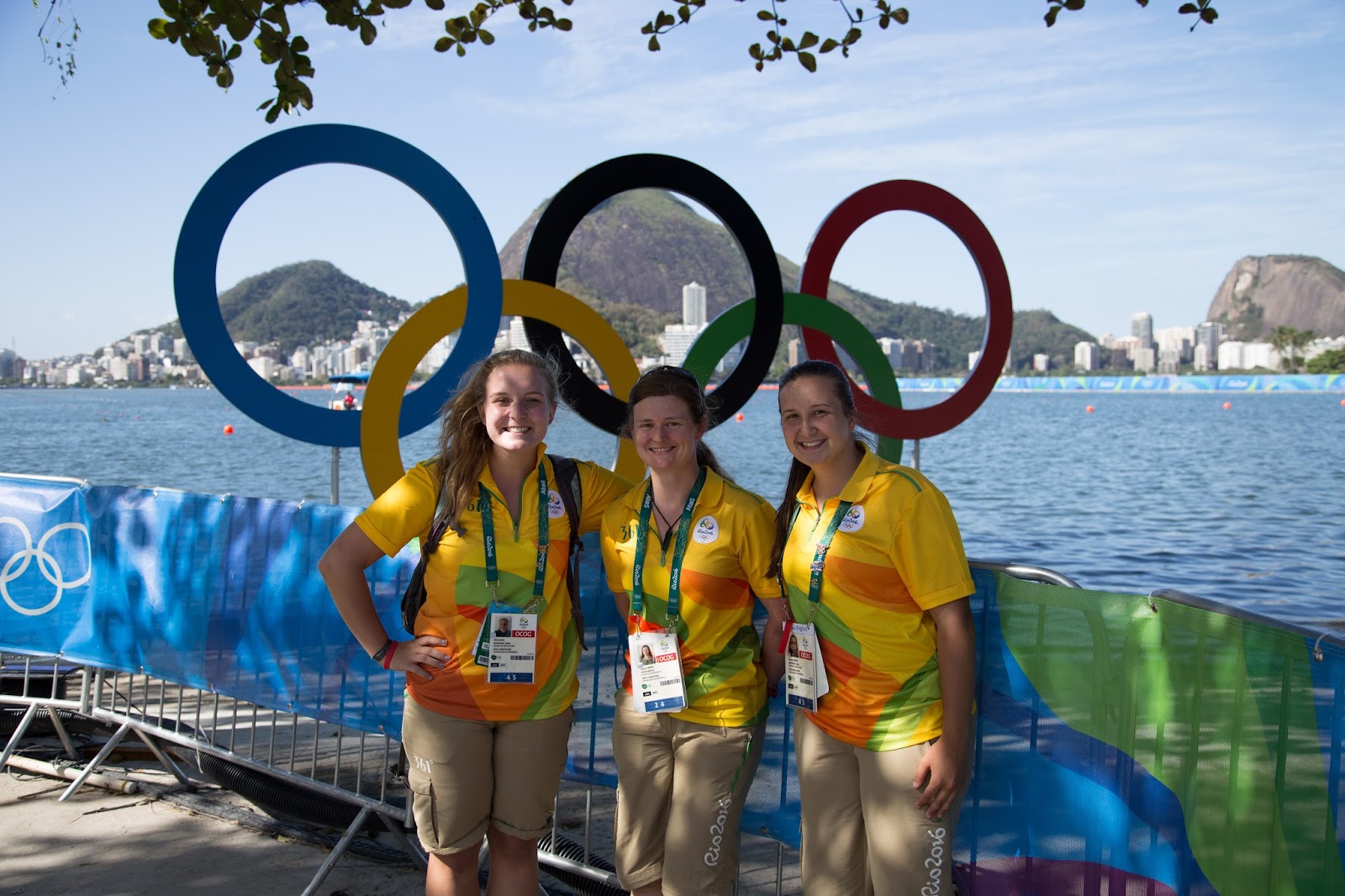
Olivia, me and Shauna and the Olympic rings
I did do some unprofessional jumping up and down with the women's pair and then pretty much missed the men's four final, managing to just see them cross the line ahead of Australia. When the Olympics are over I'm going to spend some time watching all the racing again as as usual I haven't really seen the whole of any races.
Today dawned bright and sunny and while a little breezy, not too windy to stop racing. The minor singles finals were pretty much as standard - a shout out to Dattu Bhokanal, who I interviewed before competition started, who missed his top 10 target but did manage to record India's best-ever rowing placing by winning the C final. Pretty good for someone who was once afraid of water.

The men's singles final happened while I was in the middle of an interview with Ekaterina Karsten (well, me, a Russian translator, and a couple of Belarussian journalists). Karsten's one of those people nobody outside rowing has heard of yet she's a legend of the sport: this was her seventh Olympics at the age of 44 and she has two golds, a silver and two bronzes from the first five Games she went to. She's pretty serious in nature and she was clearly not happy to be going out with eighth overall (second in the B final) but she did say she won't row in Tokyo. What was perhaps saddest was her answer to my question about whether she thought she was an inspiration for others; she said most young people these days spend all their time staring at a smartphone and she doesn't think any of them have role models they follow.

I managed to catch the end of the men's singles - the Croatian journalists were yelling, Mahe Drysdale and Damir Martin slumped, and it seemed to take ages for a result. To be honest, I'm glad it went the way it did (see World Rowing's tweet for a picture of the finish!) as Mahe is a very decent man and I suspect this was his last Games. Martin is 10 years younger and will definitely have another chance.

The women's singles was an entirely different race - my flash quote reporters, being American, were thrilled with Gevvie Stone's silver which was very well-deserved.

And then on to the eights. Somehow I managed to be relatively free for the women's eights final so watched it, heart in mouth, on one of the mixed zone TVs with British Rowing's press officer Caroline next to me. The British eight got out to such a bad start but they paced the race brilliantly - although Romania's charge was incredible. Romania was absolutely thrilled with the bronze and sang a song when they got to their national broadcast interview, but it was so lovely seeing the British women embrace their coaches in the mixed zone (with the mixed zone team trying to shepherd them around the correct route) and then hear them speak about the way they approached the race and what it meant to them.

I was so busy typing up their quotes that I missed the men's eights final until I heard shouts for the Netherlands outside the tent, so I leapt up and rushed outside to see our guys cross the line clear. Caroline and I hugged each other and then it was back to work. But I did have a 10-minute window before press conference quotes came in to go and watch the medal ceremony and sing the anthem. I was very proud to be British.

After everything was filed and all the spectators had gone home we got a few shots of our little ONS team, and later more of the press ops team. It felt weirdly like the end, even though we still have a week of canoe sprints left.

Tomorrow I'm on athletics - the women's marathon in the morning and athletics in the evening. It's the men's 100m final so I expect it'll be slightly crazy. But that's what the Olympics are all about. Looking forward to it!