Monday, January 22, 2018

New Plymouth, Wellington and the Wairarapa

This post is brought to you by an afternoon of wine tasting.

When I settled in Wellington back in 2007 I started my job just after Easter, so I spent the long Easter weekend out in the Wairarapa, exploring LOTR locations and drinking wine. When I was working we had quarterly days out, one of which was a fabulous trip to Martinborough for golfing and wine-tasting. I therefore have fond memories of Martinborough and decided to put it on my list of Things To Do for this trip. Consequently, after an afternoon tootling around the vineyards on a bike, I am moderately sozzled.

 Going backwards: after Northland I drove south to New Plymouth, which last year was named the second-best region in the world to visit by the Lonely Planet. This is quite a big thing to live up to and I'm not sure it can quite lay claim to that title - but it depends what you want from a place. I was unfortunate with weather this time, as it was wet most of the time I was there, but I did thoroughly enjoy my day in NP. I had a lovely dinner with my friend Delwyn and then the next day explored the excellent museum Puke Ariki before the rain eased enough to venture onto the Coastal Walkway. NP council has now developed 13km of fabulous path along the coast - it was pretty blustery but fun and worth braving the wind for. Then I cut in along a path which runs along a really pretty little stream (Te Henui) until I got to the end, before finding my way back to my hostel through the NP park. It was a good 12km walk so I felt suitably virtuous by the end and that I'd earned the fish and chips I had for dinner.

Cape Egmont lighthouse and Mount Taranaki
From NP it was on to Wellington. I took the Surf Highway, which runs along the coast and through numerous tiny towns with crashing waves on one side and rural NZ on the other. It was a lovely drive; I took a detour to see the Cape Egmont lighthouse with Mount Taranaki peeping through the clouds behind before barrelling on south past all the towns we used to drive through on the way to swimming meets or regattas when I lived in Wellington. Taranaki's farewell signs were particularly good: "You are about to leave Taranaki ..." and then a couple of hundred metres further on, "Why?"

It was very good to get back to Wellington. It really is an awesome little city. I drove in as the sun came out and after checking in to my hostel and dumping my car headed up to Mount Victoria for a view. This was pretty much the first thing I did when I first arrived back in 2007, guided by my brother and now-sister-in-law. It seemed appropriate to do it again and it was a good clear day.

Originally I'd hoped to go rowing at some point but the Wellington wind had other thoughts and on Saturday it was a raging north-westerly with white caps across the harbour. I hired a bike instead and cycled around the bays - a trip I did several times when living in NZ. The road takes you past a number of lovely neighbourhoods, past the airport, and then eventually up a long drag back to town. I missed my road bike massively (even the hybrid I owned in NZ was better than the mountain bike I'd hired) but it was a good day.

Breaker Bay
Since I lived there Wellington has sprouted several markets - I enjoyed wandering the Underground Market on Saturday and the Night Markets on Cuba Street on Friday and Saturday were good too. Lots of street food from around the world, NZ handicrafts and the like. I had a Vietnamese banh mi for lunch on Saturday and a plate of Ethiopian food for dinner - delicious and relatively cheap. Food is quite expensive in NZ so it was good to save a bit, although I confess I also had a couple of craft beers at a cool little pub in the CBD I found via Google ....

On Sunday I went to Te Papa, New Zealand's national museum, which was as superb as always. They had an exhibition of Lego models of Wonders of the World - amazing - but arguably a better show was their Gallipoli exhibit, This was designed in conjunction with Weta Workshop, who made their name making models for the Lord of the Rings films, and focuses on the eight months spent by New Zealand troops trying to take a part of Turkey during WW1. Gallipoli is a bit of WW1 which we in Britain don't know much about (despite the fact several thousand British troops fought there too) but it was a crucial, tragic part of the war for the Aussies and Kiwis. Thousands of their men died there before the troops were evacuated and it was a tragic event for the whole country. The exhibition tells the Gallipoli story through the voices of individual soldiers and includes immense 2.4x models of eight individuals - seven men and one female nurse - who were involved. It was a very powerful way of telling their story and brought home to me a side of WW1 I was aware of but knew little about.

The giant model of Lt Spencer Westmacott which introduces the Gallipoli exhibition
A good accompaniment to this was a visit to the Great War Exhibition, likewise curated by Peter Jackson and his Weta colleagues, at the National War Memorial before I left. This also relies heavily on models to show you what went on during the war, coupled with colourised photographs and artefacts. It was also exceptionally good and complemented the Te Papa exhibit well. Both made you feel what an impact WW1 had on NZ and Australia, whose sons went off to fight for an empire they were so very distant from.

The rest of my time in Wellington was spent with a catch-up lunch with my rowing friend Lucy, appropriately next to the rowing club in the new-since-I -lived-there cafe by the club (it was too windy to row), a visit to the Wellington Museum, and a pilgrimage to the Embassy Cinema to see The Post. The Embassy has, since I lived in Wellington, added two new small screens below its awesome main screen and it was in one of these that the film was shown. It was lovely - a comfortable seat and a glass of wine!

Yesterday after the Great War Exhibition I hit the road for Martinborough, driving out over the Rimutaka Hill to the Wairarapa wine country. I rented a bike from the holiday park I'm staying at and set out to taste wine. I tasted a lot. It was all good. I didn't buy any but most of the wineries charge $5 for a tasting so you kind of feel okay about not buying, and I bought a mini bottle of gin in one of the two which didn't charge which I sincerely hope will survive the next few weeks. It would frankly be a tragedy if it didn't.


Wednesday, January 17, 2018

Auckland and Northland

My flight from Kuala Lumpur was late leaving and later arriving in Auckland. But New Zealand is the sort of place which actively welcomes travellers, and even at 1am it felt so very good to be back.

I'd always wanted to go to NZ but it took me until February 2007 to finally get there, when I went out on a working holiday visa with very few expectations of how long I'd stay and what I'd do. I stayed two years and got a proper job, but came home for career and family reasons. However I was there long enough that even arriving at stupid o'clock in a city I don't know so well it was a bit like coming home. The whole sense of the place is unique; it's enough like the UK that it feels comfortable, but there's enough Kiwi character too to set it apart from home.


After a long sleep I dove into NZ with a cup of coffee. Kiwis do coffee exceptionally well, even in the smallest town, and this cup was wonderful. Revived, the Auckland Museum was calling as they had on an exhibition of entries from the New Zealand Geographic Photographer of the Year competition. This was great, mixing stunning landscape and wildlife photos with some more documentary-style images of NZ's people and places. It didn't shy away from touching some of the less well-known topics such as the hardship of being a refugee here, alcoholism and homelessness, and the intense poverty suffered by some in the very rural areas of the country.

In the evening it was time for my first catch up with friends of my trip - drinks by the harbour with Dave, a colleague from the Olympic News Service, watching the sun go down. I decided I liked Auckland more than I'd remembered!

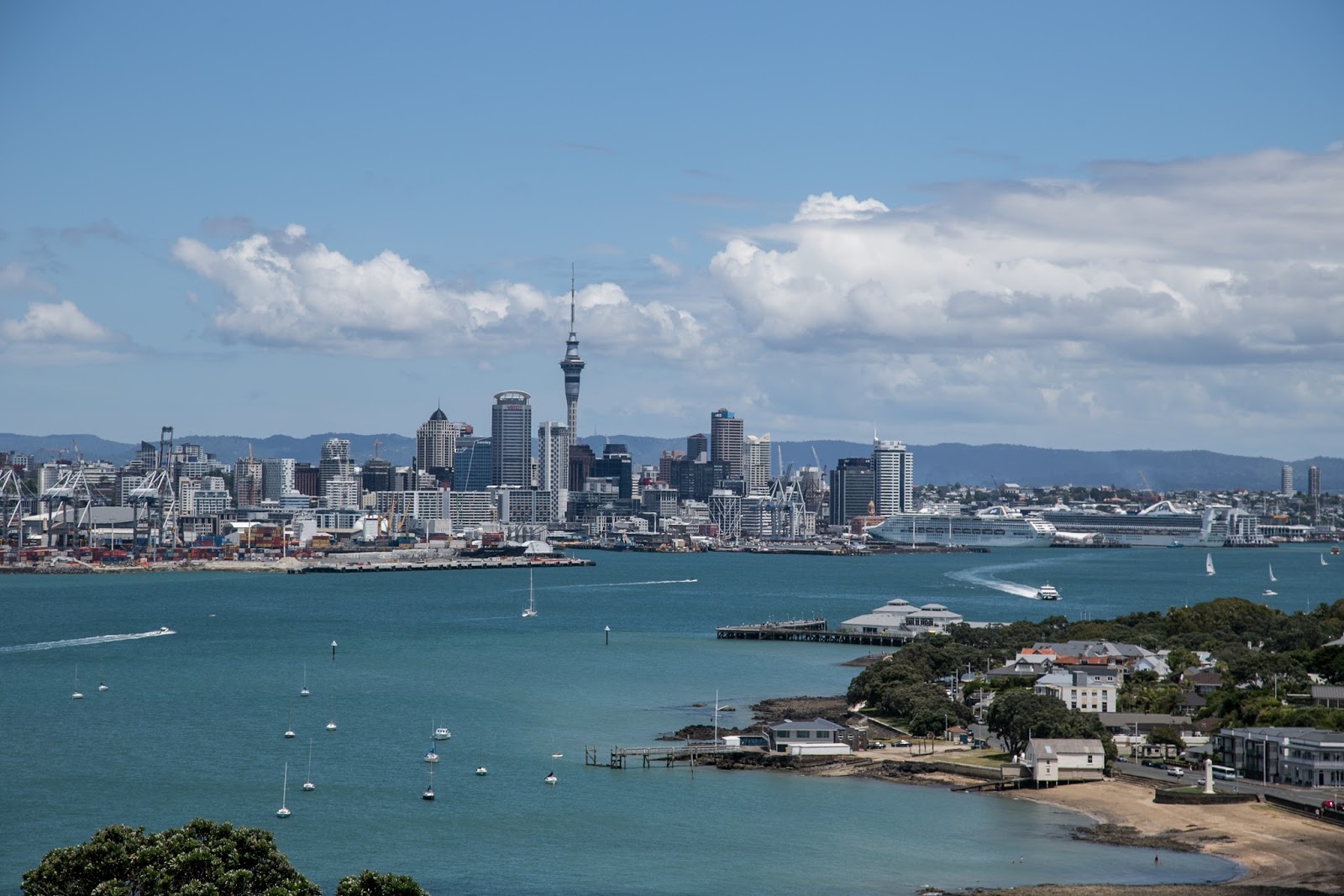
Day two was more catching up with friends, after I'd got lost finding their place and driven over the harbour bridge twice ... Sarah and her boyfriend were great hosts for the day, with a trip to the French Markets in Parnell (a kind of foodie farmers' market which pops up on weekends) followed by a drive to Devonport for views of the city, and a few beers nearby.

But I had to get out of Auckland after that. The only problem with having spent a reasonable amount of time in NZ is that I've seen quite a lot already, so I struggled slightly to decide what to do (and where to stay). After mulling over maps and booking websites for far too long, I plumped eventually to drive north and go and see the kauri forests.

Tane Mahuta
Kauri (Agathis Australis) are ancient trees, both in terms of the species and individually. They can grow for thousands of years and reach incredible heights and size.They only grow above the 38 degree latitude line and are rare and surprisingly delicate for trees of such majesty, being prone to something called kauri dieback. The Department of Conservation are tackling this by requiring you to walk on dedicated paths and clean your shoes before and after going into a kauri forest.

On the way north I stopped off at the Kauri Museum in a little settlement called Matakohe. The museum is actually fairly pricey to visit, costing the same as a visit to the Auckland Museum, but it turned out to be a fascinating place with every aspect of kauri production covered - harvesting the gum they produce, which was used for varnish, and digging old gum out of the ground; digging up logs of kauri from swamps, where it's preserved and usable; and transporting kauri logs down rivers through special kauri dams. The museum also covers the life of the early NZ settlers. It's very well done and taught me a lot I didn't know about the use of kauri.

In the kauri forests I went to see three key trees or groups of trees: the Four Sisters, which are relatively small kauri growing together in a group; Te Matua Ngahere, or Father of the Forest, which is the fattest kauri known to be in existence right now; and Tane Matua, Lord of the Forest, the tallest and biggest kauri. You can't get very close to the latter two, to protect them, but you get close enough to appreciate the size of these astonishing trees. Even with a fairly wide angle lens I struggled to get them in one shot!

I stayed that night at a fabulous place south of the main kauri forest in the middle of nowhere. A chap called Richard Bird and his partner, who moved out from the UK almost 20 years ago, run a holiday let from their home set amid 35 acres of bush. One of the places you can stay is a 'tin shed' set in seclusion up a steep track, looking out over the bush and a field. It has an outside bath and cooking area but the bed was incredibly comfortable, and after an evening relaxing in the bath and drinking wine on the deck I slept like a log! Sadly it was too cloudy to see any stars.


In the morning I had a wander around another kauri forest nearby, before setting off south. The last Northland stop was at Bayly's Beach, which is a small section of the 107km-long Ripiro Beach - NZ's longest 'drivable' stretch of sand, even longer than the more famous Ninety Mile Beach which is really only 88km long. It was good to look at the sea crashing on the sand before the long drive ahead of me.


Friday, January 12, 2018

Two days in Kuala Lumpur


When you've spent the last few weeks shivering in a damp British winter, hitting the heat and humidity of the tropics is a bit of a shock to the system. But despite struggling a bit in the intense mugginess of Kuala Lumpur I thoroughly enjoyed my two days in this lively city.

KL reminded me a little of Singapore, although smaller, less tidy and well-organised, and arguably the nicer for it. The centre is reasonably walkable despite the heat and public transport is excellent. It's a very vibrant, multi-cultural sort of place with all sorts of people jostling along together.

I spent the first day wandering around the centre near my hotel and the second day visiting some of the main attractions.

First stop on day 1 was the Masjid Jamek, a small modern mosque quite close to my hotel which is built out into the river – an area they're clearly trying to regenerate and tidy up. The mosque was very pretty and peaceful. A nice Syrian guy told me a little about the main prayer hall but I mainly just wandered for a short while taking pictures and absorbing the atmosphere.


I tried to find the Masjid India next, but took a wrong turning and ended up somewhere else instead, so meandered down to the Central Market on the edge of Chinatown. Blissfully this was air-conditioned so although I had no desire to buy any of the stuff on offer – mainly handicrafts for tourists – it was nice to get out of the heat for a bit.

KL has a number of walking tours with route maps placed along the way so I followed the Chinatown walk past several Chinese temples loaded with gilt and pungent with incense, and into a Hindu temple which was bright with colour and figures of their gods.


I found a little restaurant buzzing with locals for lunch, where I had to enlist the waiter's help as there were no descriptions for any of the dishes and I'd only heard of a couple of them. I ended up with a plate of noodles fried with chicken and shrimp and egg, which with an iced coffee came to less than £3. Bargain!

The hub of KL's Chinatown is Petaling Street, a street which is now covered with a roof to enable market traders to ply their knockoff designer handbags and watches at all hours of the day and night. It's festooned with Chinese lanterns but it could be anywhere, and while it's interesting for people-watching it's not exactly selling high-quality wares. However there was a stall selling fruit so I got a vitamin boost with a bag of fresh pineapple!

After a short stop at the hotel for more water I continued my wandering, up the hill towards the KL Tower. This is one of the city's landmarks, one of those tall towers with an observation deck and revolving restaurant on the top. Surrounding it is an 'eco-park', a splodge of conserved rainforest with paths through it and a raised treetop canopy walk. There was a picture of a monkey on the website and I was hopeful of seeing some but in the event the only things I saw were a lot of trees and some biting insects. It was also even more humid under the canopy, so I cut the walk short and went to look at the tower instead. It seems to have a few restaurants and stuff, nothing of great interest; I exited through a chocolate-and-coffee shop which was absolutely mobbed by a vast Chinese tour group scrambling for bags of chocolate. I beat a hasty retreat.

Ate Indian for dinner – a vegetarian thali full of unusual and unidentifiable things, which was spicy but good. When I came out of the restaurant it was raining and it didn't stop raining for the following 36 hours (and was still raining when I left KL). I was a bit worried this would make my pre-booked trip up the Petronas Twin Towers a wash-out, but as it happened there was still a decent view.


The Petronas Towers are the other KL landmark everyone's seen. For a while they were the world's tallest building and are still the world's tallest twin towers, linked by the world's highest 'Skybridge' – although the bridge isn't really connected to the towers, so it can move when they sway in the wind. There's an efficient tour system going, where they sweep you in groups up various lifts; you get about 10 minutes on the Skybridge and 20 on the 86th floor observation deck, plus a pointless 10 minutes on the 83rd floor where they try and sell you the photos they've taken of you. Although the enforced time on the various levels was irritating it was worth going up there for the stupendous views of the city – I imagine they'd be even better on a clear day!


Next stop was the KL Bird Park, billed as the World's Largest Free-Flying Aviary. Like the bird park in Iguacu Falls, this means a lot of the birds get a massive space to fly around in although there were some in enclosed aviaries too, like the most gigantic hornbill. It was sheltered so the ongoing rain wasn't such a problem and I enjoyed going round looking at the various birds – there were also some monkeys climbing around on the outside of the aviary's netting.

I wanted to go to the national mosque but with time to kill stopped off at the Islamic Arts Museum, a beautiful building with Islamic domes filled with all sorts of art and artefacts relating to Islam. They had a huge collection of illuminated Qur'ans, armour, jewellery, clothes and ceramics from across the Islamic world and I spent a good couple of hours wandering around.

The Masjid Negara – literally, national mosque – was the final stop of a long day. I had to wait with the other tourists to go in, and then as at the Jamek mosque cover myself up in a lovely hooded robe (on balance, I prefer the hooded robe option to the headscarves and aprons which Orthodox churches in Russia and the CIS give you). On my way in a friendly gentleman said hello and a short while later waved me over to where he was starting what I thought would be a brief explanation of the mosque in the same way that the nice Syrian guy did at the Jamek mosque.


Oh how wrong I was. After a simple introduction of the prayer hall – how many people it holds, etc – we went on to the central tenets of Islam, why men and women must be separated at prayer, then on further to the way the Qur'an agrees with modern science on issues like the Big Bang. After about half an hour we got taken downstairs to a hot little room where at least there were chairs, in order for a multimedia presentation of science and Islam and verses of the Qur'an on an iPad. It was initially quite interesting but he kept talking and talking and talking. I was hungry and tired and too hot in my purple robe, which was made of some horrid synthetic material, and when we started getting on to why there isn't equal treatment of men and women and why this is for women's protection I made the excuse of needing fresh air and escaped.

Now I'm all for embracing other people's beliefs, and I like finding out about other people's culture. But it was the end of a long day, my blood sugar was dropping and after an hour of being talked at my tolerance levels had dipped to nothing. It was a shame as what I really wanted was to look at the mosque in a more leisurely fashion for 15 minutes and then head off to find some dinner. In the end I took a few rapid photos and got out of there, and my dinner was eaten too quickly as I was so hungry by the time it came. It was a slightly disappointing end to an otherwise good day.

Overall I'd recommend KL as a stop, and actually I'd like to visit more of Malaysia if I get a chance – it seems a beautiful country with friendly people and good food. So long as I can find a cooler time of year to do so!

Getting around Kuala Lumpur

KL was dead easy to navigate and public transport was excellent. I got the KL Ekspres train from the airport to the central station (KL Sentral) for RM55 return (about £10). Then I got the LRT (=metro) to my hotel. They have two-day transport passes including the Ekspres but it wouldn't have been economic, so I just bought single fares each time I used the LRT. It's incredibly cheap but the fares depend on how far you're going; you pay and get a token which is then used like a contactless/Oyster card at your departure station, and fed into the ticket gate at the arrival station to get out. If you change you seem to have to buy a new token, I couldn't work out a way to get a ticket all the way through when I changed from one line to another to go to the mosque/museum/bird park! 

Monday, January 8, 2018

Musings of an insomniac traveller

I have a travel secret. I can read anywhere.

When I was young and we went on holiday there would always be a layer of books at the bottom of the case, to keep me occupied during the trip. I'd have a couple of books in my carry-on and another three or four, if we were away for a week. If a fortnight, I'd try and find big fat difficult books which would theoretically keep me going for longer. I read fast, and I read everything.

If we were driving somewhere on holiday, even better; there'd be a bag of books in the back seat with me. I'd open a book as we left our driveway and my head would be down, disregarding the view, until we got to our destination. I travelled twice everywhere we went – once physically, and once through my books. That's why the Kindle has been such a blessing, especially now I'm travelling more for longer. Gone are the days of taking up half the luggage allowance with books, and gone are the days of hoping tonight's hostel has a decent book exchange so I can switch the trashy novel from two days ago with something else I might not have read.

I don't get travel sick, or seasick. Everyone else in the family would munch on pieces of crystallised ginger to help keep nausea at bay if we took the ferry to France. I'd have a piece too, mainly because I liked it. Even in the roughest seas while sailing I've felt fine. I don't particularly like rough seas, or turbulence in an aircraft, but I don't get sick.

But I don't sleep well while travelling. I'm writing this at 9.20pm British time, which is 5.20am somewhere over the Himalayas, monochrome and majestic in the dark below us, and 6.20am in Seoul, where this plane is headed. Oh, and 1.20am in Abu Dhabi, where we took off from. I've just been trying to sleep for the last couple of hours or so; I think I've dozed a bit but I couldn't actually sleep. When I get to Seoul I have a four-hour window to go through immigration, collect my bag, and check in again for the next leg to Kuala Lumpur (where it's also 5.20am).

Perhaps it's also excitement at the prospect of the next eight weeks or so that's keeping me awake. After getting back from Rio and South America in November 2016 I've been longing for another decent trip. Last year's holiday in Georgia with Julie and Andrew was excellent, but somehow three weeks after the big three and a half month trip seemed like nothing. So when the offer came through last year to work as a reporter at the PyeongChang 2018 Winter Olympics I leapt at it, and started planning how I could extend the journey for a bit longer.

Initially I'd thought of going to Japan before or after PyeongChang. Flights between Korea and Japan are cheap and I do want to visit. After thinking about it I decided to delay Japan for another time (fingers crossed, Tokyo 2020!) and to take the chance of going back to New Zealand as I was already halfway there.

I had to then work out a way of getting to NZ easily from Korea, as my flights were booked return London-Seoul. It so happened that direct flights to Auckland from Seoul were horrendously expensive; direct flights the other way a few weeks later were much cheaper. But there were some good deals between Seoul and Kuala Lumpur, and between KL and Auckland, so that's what I've ended up doing – although I didn't really think about just how long the London-KL journey would be when I booked it.

NZ is the real draw. It's 11 years now since I first went out there on my working holiday visa. I settled in Wellington and had a fabulous two years with a good job. I went back in 2010 for the rowing world championships at Karapiro, and stayed for a hectic two weeks. This time I have a little longer, and have planned a circuit of the North Island with the four-day Tongariro Northern Circuit as the main event towards the end of the trip, combined with plenty of catch-ups with friends and the aim to ensure I eat and drink everything I've missed (Kiwi fish and chips, golden kiwi fruit, Monteith's Summer Ale, Ata Rangi rosé wine in Martinborough, green-lipped mussels, Whittaker's chocolate …).

And then it'll be back to Seoul for a few days' sightseeing including a tour of the Demilitarised Zone between North and South Korea before taking the fast train to PyeongChang for three weeks of immersion in the Olympic bubble. Afterwards I have a week of decompression travelling around Korea, yet to be planned properly. In total it's two months of travel. I know it'll be gone in a flash.

It's now 5.35am over western China and I've properly woken myself up by blogging. Time to pick up the Kindle and read a bit. Maybe then I'll sleep.

(In Seoul, waiting for check in for the next flight: I did sleep, for a couple of hours, although feel a little blurry still).

Monday, July 17, 2017

L'Etape du Tour 2017

Well, I finished it. I'm not entirely sure how, and the last 9km nearly killed me. But I finished the Etape du Tour 2017, have a shiny medal to prove it, and did not walk up any of the hills.

I didn't sleep well the night before. I turned out my light early, snuggled into my sleeping bag and closed my eyes. And then the French kids in the glamping tent next door started chattering and going to and from the loo or something. When they stopped, there was a very long and drawn-out fireworks display going on. So I definitely didn't get as much sleep as I wanted, but I still woke before my alarm and was at the village dumping my bag and availing myself of free coffee and a rather excellent pain au raisin ages before I needed to. I got to my start pen early too, which meant standing around in the cold people and bike-watching for a while.

Pre-ride selfie

At just gone 7.30am my wave headed out. I knew from recce-ing the course the day early with my friends Soph and Pete that the first section was fast, with a particularly rapid descent about 10km in. Aware there was a long day ahead I tried to pace myself, not push the little ramps too much and not worry about the people racing past me. Later on I was extremely glad of this. The first part of the course was absolutely stunning, especially arriving on the shores of the Lac de Serre-Ponçon which is, apparently, one of Europe's largest artificial lakes. It's a stunning turquoise surrounded by mountains and it was beautiful to cycle past.

The first climb of the day was the easy Côte des Demoiselles Coiffées, literally the 'hill of the girls with hats on'. It was a nice little climb by the lake and again I tried to take it easy, without pushing too hard. The climb was followed by a really thrilling, stunning descent with the lake ahead, on a wide road with several hairpins. I'm not good at descending really but I rather enjoyed swooping around the corners (being passed by more fearless riders as I did so) in such stunning scenery. 

After that we headed into a gorge with mountains ahead. I tried to take a picture but had left my phone on selfie mode after my morning selfie and couldn't manage to switch while riding, and I didn't really want to stop. I passed the 100km to go sign and felt okay and then as my Garmin ticked over to about 90km in, 90km to go I hit a mini-wall. Luckily some food helped and I picked up the pace again.

I reached 100km in within about 3 1/2 hours, well ahead of the four-hour limit I'd mentally given myself, and feeling pretty good about life. Every village had come out to support us, with the constant shouts of "Allez les filles!" particularly motivating somehow - the French, especially women and girls, are very good at supporting the few women who do the Etape. Only 594 women completed it this year according to the  results, out of 11,206 participants. 

Coming out of the 100km feed station I got chatting to a British guy called John, from Surrey, who had smashed out the first part of the race. We had a good natter which meant the next 20km flew by, although our attempts at creating a mini-peloton backfired when everyone who had hung on our tails decided not to play ball. John asked if I minded him cycling with me up the first big climb of the day, the Col de Vars, which was fine by me. However only a little way into the climb - which averages 7.5% over 9km - he was flagging. I was struggling to keep my pace at the same level as his and when he said "go on", checked he had enough water and food and then carried on at my own pace. 

Near the top of the Col de Vars
 I didn't find Vars too tricky actually although I did stop once for water as it was so hot by this point, and I felt I wasn't taking on enough when drinking while I was cycling. I refilled both my bottles at the top and then whizzed down the descent - almost 20km of non-stop downhill to Guillestre, the final feed station, which had a nasty kick up as you entered the town. But the whole place was out cheering for us. With more food on board and only 30km to go I was feeling pretty good about myself as I rolled out - tired, sure, but certain I could finish. 

The road carried on up a 'false flat' averaging around 2% gradient for about 15km, also through a gorge. There were several little groups it was easy to latch on to for a while and I enjoyed slinging my way from one to another. There was some shade, the climb wasn't too bad, I had plenty of water ...

And then we hit the Col d'Izoard proper. Izoard is a hors categorie climb in Tour de France parlance, allegedly 14km at 7.3% average, although I kept seeing10%+ on my Garmin so I'm not sure I believe that! And just after the start of the climb my back got suddenly very painful, I really needed the loo, and I stopped dead for a while. It was about 5km to the next water station and I could see the slope ahead. Somehow I got back on the bike and, with my stomach and back sore, struggled to the water stop.

At the water stop the place was full of prostrated cyclists. Bikes were abandoned all over the place and people were sitting in the few patches of shade panting and agreeing it was extremely hot. I caught my breath, had a drink, decided what my game plan was for the last 9km and got to my feet.

Essentially I decided that I'd stop every 3km to the summit. There was a little less than 9km to go. Every kilometre I had a drink and I stopped twice for several minutes of water and Jelly Babies (melted to a lump, but still capable of delivering a crucial sugar boost) before carrying on. But I got back on my bike each time and pedalled the whole way up. Lots of people had just given up and started walking. According to the official timer, including the stops, it took me just over two hours to complete those 14km.

At the finish
Crossing the finish line was weirdly intensely emotional. I was short of breath from the altitude (2,360m) and completely exhausted. I did the obligatory selfie, took some pictures for a couple of other people, and then just sat down and cried for a moment until I'd caught my breath and gathered myself together. I don't know why I felt so emotional. 

And then it was just another 20km, mostly downhill, back to the village in Briançon, where they hung medals round our necks and handed us water bottles (got to say the Etape did well on the stash front this year).

It was a good ride. I'd go so far as to say 100 miles of it was incredible. The scenery was phenomenal and there's a real buzz from riding with so many other people from other countries. But it was really, really tough at the end there. The comfort was that everyone was struggling, of all ages and genders, so I didn't feel too bad about it!

Will I do another Etape? Probably, because I'm a sucker for punishment and need a challenge. I just hope it's not quite so hot next time.


My Strava data

Friday, July 14, 2017

Une petite semaine en France

I like France. I had a thoroughly enjoyable year in Nantes while doing my degree. I like the language, the culture and the food and yet I've barely spent any time in the country since leaving university.

Travelling to cycle 180km with a mountain-top finish is possibly an extreme way of resolving this issue, but that's what I'm currently doing.

The Etape de Tour is a massive cycle event which happens every year during the Tour de France. Its organisers pick a stage of the Tour and, a couple of days before the pros come through, about 15,000 mad cyclists from all over the world sign up to try and complete it. I did this two years ago on a fiendishly difficult stage with several climbs, and while it was the hardest thing ever I kind of enjoyed it in a masochistic sort of way. So in December, when I was feeling a bit post-South America bluesy, I rashly signed up for the 2017 edition. And then did nothing about it until the end of May, when I decided that yes, I was going to go.

This uncharacteristic lack of organisation means I probably haven't done enough training. It also means I travelled out independently, failing to get sorted to team up with the few friends who are also riding it (though we're meeting up tomorrow). So I sent my bike on a bike transport service and flew with Ryanair to Grenoble and stayed the first night in Grenoble, which was a lovely city with a nice old centre that I enjoyed wandering around before treating myself to steak-frites for dinner. I got a bit worried my French had completely gone when I couldn't communicate with the waiter, but it turned out he was part-Corsican, part-Vietnamese and both of us were struggling with each other's weird accents.

View from the train

Yesterday I caught a train from Grenoble to Gap and another from Gap to Briançon, where the Etape starts and finishes. It was a nice journey with lovely views, the trains were comfortable and exactly on time, and I rather enjoyed the trip. 

I'm staying in a campsite a little outside Briançon, having failed to find a hotel with rooms. I haven't camped for ages either and although it took me a while to get to sleep last night the campsite's nice, with really friendly owners and a little pool for a dip. And it's only 10 minutes by bike into town.


Today to warm up my legs a little - and give myself confidence for the Etape on Sunday - I picked a relatively short (11.4km) but also relatively tough (9%) climb, the Col de Granon. It's a good climb with lots of amazing mountain views and finishes quite high up so was also good for altitude acclimatisation. I was pretty slow, but steady, and even the 11.1% section wasn't too bad. The descent was fast but less fun. I don't like descending!


Traditional top-of-col selfie
It's nice to be in France again and speaking French a bit, and hearing it all around me, and I'm now actually looking forward to the Etape and its challenge on Sunday!

Monday, May 1, 2017

Hot springs, caves and ... Stalin

(A belated catch-up on the rest of the Georgia trip).

The last destination on our tour of Georgia was the spa town of Borjomi. During the Russian Imperial era Borjomi was a favourite hangout of the Tsars and Grand Dukes of Russia, who came to sample the waters just like the rich and famous did with Bath and Harrogate in the UK.

Nowadays Borjomi is a nice little resort town and the mineral water park is the centre of tourist activity. They've restored the springs, built a little amusement park with some rides and so on (closed in April) and there are some big hotels and plenty of guesthouses. We stayed in a guesthouse run by former teacher Nino with help from her policeman husband Temuri and, on the first night, found ourselves fed yet more (homemade) chacha which left us all a bit bleary-eyed the next morning.

Borjomi's supposed to be a great place as a base for walking but we were a little short of time and we agreed that the day we had there should be used to visit the cave city of Vardzia. Vardzia is a large complex of caves dating from the 12th century, used not only as a monastery but also as a place where normal people lived, once. It suffered from a major earthquake in 1283 and the front of many of the caves fell off as a result, but what is left is pretty amazing. We were there quite early and spent a good three hours wandering around the site, listening to the world's slowest-paced audio guide - which was informative, but took its time getting to the point!

The highlight was the secret passageway built round the back of the church. The tunnel was designed as a refuge in case of invasion, and could be closed off with boulders. It was pitch black and we navigated it by the light of mine and Andrew's phone torches, occasionally banging our heads on the very low roof and eventually coming out a couple of layers above where we started, looking down on the church and the rest of the city below.


The fact that people delved into the cliff like this all those centuries ago is really mind-boggling and the scale and sophistication of the place equally so. There are stables and wine-presses and storage rooms, frescoes and carvings, and all incredibly well-preserved.


After a long day driving to and from Vardzia we decided to end the day with a swim in Borjomi's outdoor pools. There was a walk to the pools through a pine forest, which was lovely, and the pools were nice although not especially warm - warmer than the air temperature, but not hot-hot. Still, we splashed around and soaked for a little while before heading back to the guesthouse via dinner.

On the way back to Tbilisi the following day we made our last touristy stop in Gori, the town where Josef Dzhugashvili - better-known as Joseph Stalin - was born. Following Stalin's death work began on a vast museum dedicated to him, and the house where his parents live is preserved on the site where it always stood, covered by a canopy bearing the Communist hammer and sickle. Apparently it's the only place in Georgia where that symbol is still permitted.

Stalin's birthplace under its canopy

The museum gets a lot of criticism for not adequately dealing with Stalin's terrible crimes against humanity, and this is fair - there is a small section on the ground floor, tucked away, which talks about the gulags and those who died under his rule, but it's tiny. Most of the museum is dedicated to Stalin's life, displaying pictures and documents and so on telling you about the young seminarian who became a follower of Lenin and then one of the world's most powerful men.

I knew very little about Stalin's life and his family and found the place fascinating. We had an English-speaking guide who whizzed us around but we were able to go back later and revisit at a slower pace (although not too slow as the museum has marble floors and high ceilings and is freezing). The most interesting section was perhaps the gallery devoted to the gifts Stalin received from all around the world for his 70th birthday; we couldn't find anything from Great Britain, but he was given a whole load of entirely useless presents with his face on.

It was a weird place in many ways, but one we're glad we stopped at and a good staging-point on the road to Tbilisi and home.